
Income Tax Act 1961 vs Income Tax Act 2025: What Taxpayers Should Know
Introduction
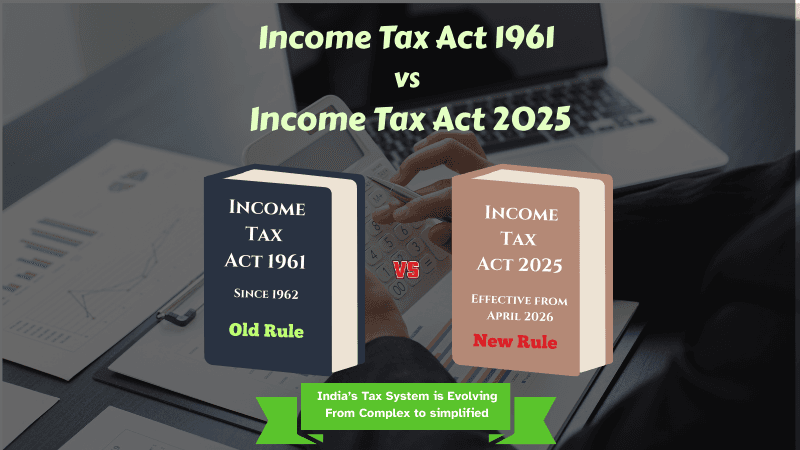
India’s income tax system has been governed by the Income Tax Act, 1961 for more than six decades. Introduced in 1961 and implemented from April 1962, the Act established the foundation for how income taxation works in the country.
Over time, several amendments were introduced through Union Budgets and policy changes. While these amendments addressed evolving economic conditions, they also made the law lengthy and complex.
To simplify the structure and improve clarity, the government has proposed the Income Tax Act, 2025. The objective of the new framework is to reorganize tax provisions, simplify legal language, and make compliance easier for taxpayers.
The proposed law is expected to come into effect from April 2026, marking an important step in the evolution of India’s direct tax system.
Background of the Income Tax Act 1961
The Income Tax Act, 1961 consolidates and governs all aspects of income taxation in India. It provides rules for:
- Determining taxable income
- Claiming deductions and exemptions
- Filing Income Tax Returns (ITR)
- Advance tax payments
- Tax Deducted at Source (TDS)
- Assessments, penalties, and prosecutions
For decades, the Act has provided a structured legal framework for tax administration. However, due to continuous amendments and additions, the legislation became increasingly complex.
Multiple sections, provisos, and cross-references often made interpretation difficult for taxpayers and even professionals.
Why a New Income Tax Act Was Proposed
The proposed Income Tax Act, 2025 aims to modernize tax legislation while keeping the core taxation principles intact.
The key reasons behind this proposal include:
1. Simplification of Tax Law
The existing Act has grown significantly in size due to numerous amendments over time. Simplifying the structure helps taxpayers understand the law more easily.
2. Improved Clarity
The new framework aims to use clearer language and reduce complicated cross-references between provisions.
3. Alignment with Digital Tax Systems
India’s tax administration has become increasingly digital with systems like:
- Online ITR filing
- Annual Information Statement (AIS)
- Data-driven tax assessments
- Electronic TDS reporting
The new Act is designed to align with this digital ecosystem.
4. Ease of Compliance
Simplified legislation reduces errors in tax reporting and improves voluntary compliance among taxpayers.
Key Differences Between Income Tax Act 1961 and Income Tax Act 2025
The most visible change between the two frameworks lies in structure and readability.
| Aspect | Income Tax Act 1961 | Income Tax Act 2025 | |------|------|------| | Structure | Long and complex legislation built through decades of amendments | Simplified and reorganized structure | | Sections | Large number of sections and cross-references | Streamlined provisions with clearer organization | | Language | Technical and legal wording | Simplified and easier language | | Compliance Approach | Traditional tax administration | Designed for digital compliance systems | | Objective | Standard tax governance | Improved clarity and easier compliance |
The intention of the new law is not to significantly change taxation principles but to make the system easier to navigate.
Key Objectives of the New Act
The Income Tax Act 2025 focuses on improving how taxpayers interact with tax regulations.
Clear Tax Rules
Provisions are expected to be reorganized logically so taxpayers can understand them without navigating multiple cross-references.
Easier Compliance
Simplified structures help taxpayers file returns more accurately and reduce the chances of errors.
Digital-Friendly Framework
The new legislation supports modern digital tax administration systems.
Better Accessibility
Simplified language allows individuals and small businesses to better understand tax obligations.
What This Means for Taxpayers
The proposed changes are expected to impact how taxpayers interpret tax provisions rather than significantly altering tax liability.
For Individuals
Individuals may find tax rules easier to understand, particularly when interpreting deductions, exemptions, and filing requirements.
For Small Businesses
Simplified tax provisions can help small and medium enterprises manage compliance more efficiently.
For Professionals
Tax advisors and compliance professionals may benefit from a clearer legislative structure when guiding clients.
Why Staying Updated Is Important
Tax laws evolve as economies grow and regulatory frameworks modernize.
Businesses and individuals who stay informed about legislative changes can:
- Avoid compliance errors
- Plan taxes effectively
- Maintain accurate financial records
- Adapt to evolving regulatory frameworks
Understanding tax law changes also helps reduce uncertainty and improve financial planning.
Final Thoughts
The Income Tax Act 1961 has played a crucial role in shaping India’s tax system for more than sixty years. However, the growing complexity of the legislation highlighted the need for a simplified structure.
The proposed Income Tax Act 2025 aims to bring clarity, improve readability, and align tax laws with India’s digital tax ecosystem.
While the fundamental principles of taxation remain largely unchanged, the simplified structure is expected to make tax compliance easier for individuals, businesses, and professionals.
Understanding these changes will help taxpayers stay prepared as India’s tax system continues to evolve.
How TaxGarden Helps
At TaxGarden, we focus on helping businesses and individuals stay informed and compliant with evolving tax regulations.
Our approach includes:
- Clear guidance on income tax compliance
- Structured tax planning support
- Assistance with return filing and documentation
- Advisory on regulatory changes affecting businesses
We combine practical expertise with a structured approach to simplify tax compliance for growing businesses.
Confused About the New Income Tax Framework?
TaxGarden helps individuals and businesses understand tax law changes and stay compliant with evolving income tax regulations.