
Different Types of ITR Filings in India: History, Sections, and Modern Use Cases
Introduction
Income tax is one of the most important sources of revenue for the Government of India. Every year, individuals, professionals, businesses, and organizations must report their income and pay taxes through Income Tax Return (ITR) filing.
Filing the correct ITR form is essential for proper tax compliance. Each ITR form is designed for a specific category of taxpayer depending on the type of income they earn.
Understanding the different types of ITR forms helps taxpayers avoid errors, remain compliant with the Income-tax Act, 1961, and reduce the risk of notices or penalties.
This article explains the history of income tax in India, the legal framework under the Income-tax Act, and the different types of ITR forms used today.
Historical Background of Income Tax in India
Income tax in India has a long history that dates back to the 19th century.
The first formal income tax law was introduced in 1860 by James Wilson during British rule. The objective was to compensate for financial losses caused by the Indian Rebellion of 1857.
Over time, various tax laws were introduced and modified until the government enacted the Income-tax Act, 1961, which remains the primary legislation governing income taxation in India today.
The administration of this law is handled by the Central Board of Direct Taxes (CBDT) under the Income Tax Department of India.
Over the decades, the tax system has evolved significantly. Today, the system includes:
- PAN-based taxpayer identification
- Online income tax filing portals
- AIS (Annual Information Statement)
- Digital tax compliance systems
These developments have made tax administration more transparent and data-driven.
What is an Income Tax Return (ITR)?
An Income Tax Return (ITR) is a form used by taxpayers to report their financial information to the Income Tax Department.
It includes details such as:
- Total income earned during the financial year
- Taxes already paid (TDS, advance tax, etc.)
- Deductions and exemptions claimed
- Final tax payable or refund due
ITR filing is mandatory for individuals or entities whose income exceeds the basic exemption limit or who meet specific conditions defined under the Income-tax Act, 1961.
Types of ITR Forms in India
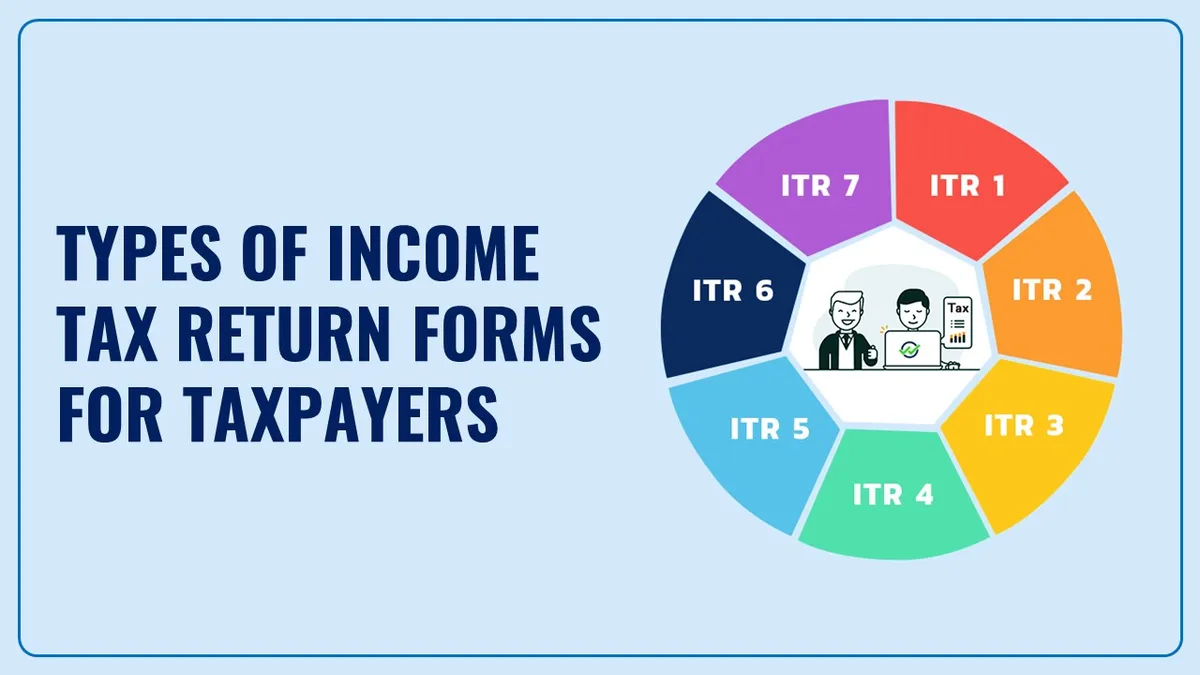
The Indian tax system currently provides seven main ITR forms, each designed for a different category of taxpayer.
Choosing the correct form depends on factors such as income level, sources of income, and taxpayer classification.
ITR-1 (Sahaj)
Who can file
- Resident individuals
- Total income up to ₹50 lakh
- Income from salary or pension
- Income from one house property
- Other income such as interest
Not allowed for
- Business income
- Capital gains
- Foreign assets or foreign income
This form is the simplest return form and is widely used by salaried employees.
ITR-2
Who can file
- Individuals and Hindu Undivided Families (HUFs)
- Income above ₹50 lakh
- Income from multiple house properties
- Capital gains from shares or property
- Foreign income or foreign assets
ITR-2 is commonly used by investors, high-income individuals, and taxpayers earning capital gains.
ITR-3
Who can file
- Individuals or HUFs with income from business or profession
Examples include:
- Freelancers
- Consultants
- Business owners
- Partners in partnership firms
This form requires detailed disclosures including:
- Profit and loss statements
- Balance sheet details
- Business income calculations
ITR-4 (Sugam)
Who can file
- Individuals
- HUFs
- Partnership firms opting for presumptive taxation schemes
Relevant sections include:
- Section 44AD – Presumptive taxation for small businesses
- Section 44ADA – Presumptive taxation for professionals
- Section 44AE – Presumptive taxation for transport businesses
Income limits generally include:
- Up to ₹50 lakh for professionals
- Up to ₹2 crore for businesses
This form is widely used by small business owners, doctors, lawyers, and consultants.
ITR-5
ITR-5 is used by several non-individual entities including:
- Partnership firms
- Limited Liability Partnerships (LLPs)
- Association of Persons (AOP)
- Body of Individuals (BOI)
It is designed for entities that are not companies but still required to file income tax returns.
ITR-6
ITR-6 is used by companies registered under the Companies Act.
However, it does not apply to companies claiming exemption under Section 11, which relates to charitable or religious trusts.
Companies filing ITR-6 must submit their return electronically with a digital signature certificate (DSC).
ITR-7
ITR-7 is used by entities required to file returns under specific provisions of the Income-tax Act, 1961.
These include:
- Section 139(4A) – Charitable trusts
- Section 139(4B) – Political parties
- Section 139(4C) – Certain institutions
- Section 139(4D) – Universities and colleges
These entities are usually non-profit organizations or institutions.
Key Sections Relevant to ITR Filing
Several provisions of the Income-tax Act define how and when tax returns must be filed.
Important sections include:
Section 139(1)
Mandatory filing of income tax returns when income exceeds the basic exemption limit.
Section 80C
Deductions for investments such as:
- Life Insurance (LIC)
- Public Provident Fund (PPF)
- ELSS mutual funds
- Tuition fees
Section 80D
Deduction for medical insurance premiums.
Section 10
Defines categories of exempt income.
Section 234F
Penalty applicable for late filing of income tax returns.
Understanding these sections helps taxpayers optimize deductions and remain compliant.
Modern Digital Tax Filing System
Today, income tax filing in India is fully digitized through the official portal of the Income Tax Department.
Modern features include:
- Pre-filled tax returns
- AIS (Annual Information Statement)
- PAN–Aadhaar linking
- Online return verification
- Aadhaar OTP verification
- Net banking verification
These developments have made tax compliance faster, more transparent, and more efficient.
Practical Use Cases of ITR Filing
Income tax filing is not only a legal requirement but also beneficial in many real-life situations.
ITR filing is often required for:
- Applying for bank loans
- Visa processing for international travel
- Claiming tax refunds
- Maintaining financial credibility
- Government tenders and compliance documentation
For entrepreneurs and professionals, regular ITR filing also helps in financial planning and long-term business growth.
Conclusion
India’s income tax system has evolved significantly from the early tax laws of the 19th century to today’s advanced digital tax ecosystem.
Understanding the different types of ITR forms, relevant sections of the Income-tax Act, and modern filing systems is essential for taxpayers.
Whether you are a salaried employee, freelancer, entrepreneur, or organization, choosing the correct ITR form ensures accurate reporting and smooth compliance.
As India continues to modernize its financial and tax infrastructure, proper income tax filing will remain an essential part of responsible financial management.
How TaxGarden Helps
At TaxGarden, we help individuals and businesses simplify tax compliance through structured guidance and expert support.
Our services include:
- Income tax return filing assistance
- Selection of the correct ITR form
- Tax planning and deduction optimization
- Compliance advisory for businesses and professionals
With the right guidance and digital tools, tax compliance can become structured, predictable, and stress-free.
Not Sure Which ITR Form You Should File?
Our tax experts help individuals, professionals, and businesses choose the correct ITR form and ensure accurate income tax filing.